
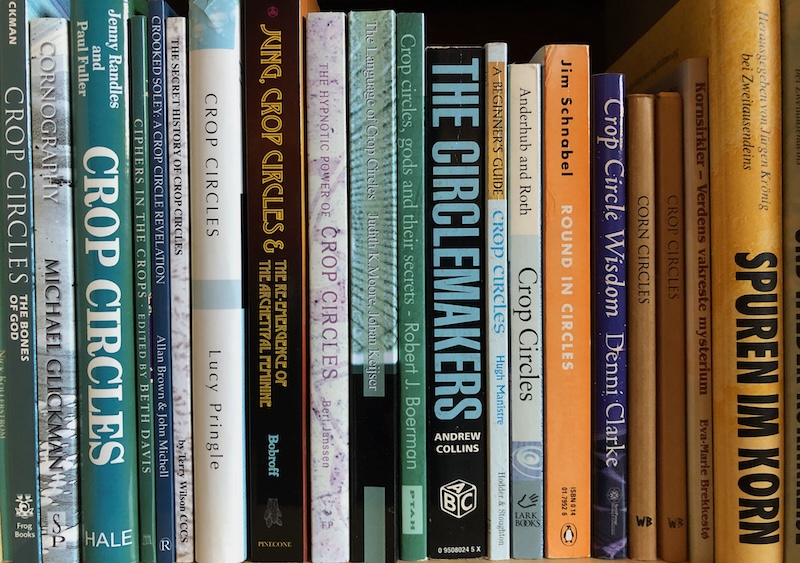
In time, we hope to feature on this page as many English language factual crop circle books as have ever existed, as a useful guide to the available literature in book form. As a starter, here are the entries from the ‘classic’ research era, from the late 1980s to the early 2000s, as described by Andy Thomas – adapted here from the 2002 UK edition of his book Vital Signs: A Complete Guide to the Crop Circle Mystery.
Sadly, a number of these authors and researchers have now passed away (not individually noted here) but their work, at least, lives on in these volumes, most of which can still usually be found second-hand online. Books are listed in rough order of publication date. Where there are several books in a year, these are sequenced in alphabetical order of author surnames.
–
CIRCULAR EVIDENCE: A Detailed Investigation of the Flattened Swirled Crops Phenomenon
by Pat Delgado & Colin Andrews, Bloomsbury 1989, 190pp
The book that launched the circle phenomenon into the public eye, documenting the authors’ discoveries in the circles of the pre-pictogram 1980s, complete with compelling anecdotes of associated strange happenings. Viciously attacked as paranormal claptrap by some who were seeking scientifically credible solutions to the mystery, this is nevertheless what caught people’s imaginations and inspired the creation of circle research groups around the world. In retrospect, its speculation is actually remarkably restrained, but brief talk of UFOs drops tiny hints at the investigative paths the authorswould soon take, well-balanced with straight observational data and copious colour photos. An essential guide to simpler times, written long before Andrews became more sceptical about many of the later formations.
*
THE CIRCLES EFFECT AND ITS MYSTERIES
by George Terence Meaden, Artetech 1989, 116pp
The first major outing for the plasma vortex theory is in marked contrast to the dramatic, populist style of Circular Evidence (qv), which just pipped this to the post as the first ever crop circle book. Scornful of unscientific paranormal posturings, the tone is calm and regimented in a clear and largely successful desire to present itself as a serious hypothesis, published just before the pictogram formations set the cat among the pigeons. This book’s greatest asset is the data, reports and valuable observations recorded within it, but underestimation of the circles’ visual attraction has resulted in only scatterings of black and white photographs. For all the theory’s difficulties in dealing with the later patterns, much of the work is still valid and Meaden should stand congratulated as the first person to attempt a straightscientific investigation of the phenomenon.
*
CROP CIRCLES: The Latest Evidence
by Pat Delgado & Colin Andrews, Bloomsbury 1990, 80pp
By now the media circus around the circles was in full swing and the front cover reflects this with its telling blurb “Could it be aliens?” next to an array of the elaborate pictograms which had shocked the world in 1990. Little more than a diary of the latest events, as the title suggests, it documents the new developments which had dated the authors’ previous tome almost overnight and was clearly a necessary publication; as such the book delivers, although its limelight was rather eclipsed by the launch of The Crop Circle Enigma (qv) the same year. Attractive photos and economic text make this anundemanding but useful read.
*
THE CROP CIRCLE ENIGMA: Grounding the Phenomena in Science, Culture and Metaphysics
edited by Ralph Noyes, Gateway 1990, 192pp
Still one of the very best circle books despite being quickly dated by subsequent events. This is a collection of sober, thoughtful pieces by the cream of researchers at the time (minus Delgado and Andrews) when they were all still talking to each other. Each contributor examines a different aspect of the mystery, recording its history, proposing mechanisms and speculating on potential origins. Excellently illustrated by a comprehensive colour roundup of circles from then recent years, photographic emphasis is on the 1990 pictograms, which had just shocked the world. Thought-provoking, yet level-headed, this presented a very credible case for a phenomenon worthy of serious investigation, cruelly dashed in the public eye just a year later by the Doug and Dave hoaxing antics which were to blight the success of its more ambitious sequel Crop Circles: Harbingers of World Change (qv).
*
CROP CIRCLES: A Mystery Solved
by Jenny Randles & Paul Fuller, Robert Hale 1990, 250pp
If you can bite your tongue at the rather over-confident title, there is a lot of useful information, reports and valid observations in this further promotion of the plasma vortex hypothesis. Randles wrote a plethora of UFO-related books over the years but seems to imply here that a large number of aerial sightings are due to meteorological atmospheric phenomena. When the pictograms started to appear, she and Fuller would go on to be openly sceptical about the complex formations, but even here there is already a fair amount of hoax speculation alongside the vortex theorising.The book is illustrated with a short section of unspectacular black and white photos and a few diagrams.
*
CROP CIRCLES: Harbingers of World Change
edited by Alick Bartholomew, Gateway 1991, 192pp
Essentially a sequel to The Crop Circle Enigma (qv), this was the first book to concentrate more on the perceived message of the circles rather than the mechanism, updating events to 1991, a year excellently illustrated with colour photographs. Like its predecessor, several leading enthusiasts of the time contribute their own personal perspective, this time reaching more deeply into speculation and soul-searching. A bit too New Agey for some, to own Enigma without also having this is nevertheless unthinkable. Sadly, it did rather less well than it might have, having the ill-fortune to be published around the same time the Doug and Dave hoax scam broke.
*
CROP CIRCLE SECRETS
edited by Donald L Cyr, Stonehenge Viewpoint 1991, 80pp
Several highly technical dissertations from six writers, based around the ‘whistler’ hypothesis, lightning-induced pulses the authors believed to be responsible for the crop circles, although at this point the early pictograms had only just started appearing. Unusually, for such a scientific view, the theory takes into account ley lines, earth energies and the connection with ancient sites. Lots of diagrams, but only a few black and white photographs. Followed by a near-identical sequel, America’s First Crop Circle: Crop Circle Secrets Part Two, Stonehenge Viewpoint 1992.
*
CIRCLES FROM THE SKY: Proceedings of the First International Conference on the Circles Effect at Oxford
edited by George Terence Meaden, Souvenir 1991, 208pp
Unattractive presentation (again only a few black and white photos) hides a collection of sometimes dry but fascinating essays on meteorological explanations for the phenomenon, compiled from reports by members of weather investigation groups CERES and TORRO and mostly based around the plasma vortex idea. The last outing for the hypothesis before the patterns appearing could no longer be simply explained by it in its basic form, this dated very quickly but contains some highly valuable information including eye-witness accounts and the full text of the ‘Mowing Devil’ pamphlet from 1678. The later findings around plant anomalies by biophysicist W C Levengood should have called for a reappraisal of some of the observations included here but by then unhelpful polarisation around paranormal-versus-scientific theories had set in too far.
*
DOWSING THE CROP CIRCLES: New Insights into the Greatest of Modern Mysteries
edited by John Michell, Gothic Image 1991, 48pp
A slim but pleasing volume which collects together some of the best dowsing-related articles from the first few issues of The Cerealogist journal, nicely presented with attractive diagrams and a few black and white photographs. Anyone with an interest in this aspect of investigation should start here, although some sceptics have criticised the differing dowsing techniques and findings outlined as being pointlessly contrary.
*
CROP CIRCLE CLASSIFICATION
by Pat Palgrave-Moore, Elvery Dowers 1991, 47pp
A brave but ultimately futile technical booklet that attempted to pin down all the component shapes making up the early pictograms so that crop designs could be concisely documented and described with code numbers. A dumbbell, for instance, is classified as a ‘181’, while a more elaborate one might be an ‘NaBg 50A’. Had the phenomenon ceased developing, this system might have worked but its evolution already challenges the book’s usefulness by the end, with complex formations like Barbury Castle 1991 forcing the system to be ditched and simply being labelled ‘No. 132’. Though perhaps unsurprisingly the idea didn’t catch on, this little book is worth owning for the most comprehensive record of crop symbols (in silhouette drawings) published to that date.
*
THE ANSWER
by Margot Williams & Carolyn Morgan, Grosvenor Press 1991, 48pp
The story of the authors’ attempts to interpret the famous 1990 Alton Barnes pictogram (the first complex formation) and other crop circles at their home on the Isle of Wight, using psychic channelling. Their experiences in the formations are recounted in a series of heartfelt vignettes, together with accounts of claimed brushes with ETs. Not illustrated.
*
THE CIRCLEMAKERS: A Revolutionary New Vision of the Crop Circle Enigma
by Andrew Collins, ABC Books 1992, 351pp
The garishly dramatic cover suggests a science fiction novel, but the reality is a sober and somewhat undervalued application of Wilhelm Reich’s orgone energy theories to the circle phenomenon. Using his explorations with a group of psychics in the 1991 crop circles as a starting point, Collins was one of the first researchers to really explore the connection between human consciousness and the behaviour of formations and UFOs, coming to conclusions then considered heretical in the nuts-and-bolts ufology world. Mainly text with a few black and white photos, this can be heavy going (page-wise, the longest circle book ever written), but it did provide a different angle on cerealogical studies for its time and, if the hypothesis is valid, has consequences for other paranormal phenomena. Collins would go on to make a name for himself in more archaeological realms but his 1994 book Alien Energy (republished 2003), which proposes that many UFOs are the result of orgone interactions, acts as an interesting sequel to this, if without the circles. The Circlemakers was eventually republished in a rewritten/updated edition as The New Circlemakers: Insights into the Crop Circle Mystery, ARE Press 2009.
*
CIPHERS IN THE CROPS: The Fractal and Geometric Circles of 1991
edited by Beth Davis, Gateway 1992, 88pp
A series of thoughtful essays by different contributors, which could almost have been included in Harbingers of World Change (qv) by the same publisher, looking at the significance, evidential and symbolic, of just three important formations from 1991: Barbury Castle, the Mandelbrot Set and the Froxfield ‘serpent’ or ‘brain’. Eight pages of colour photos help make this a valuable tribute to what were then the most spectacular designs to have appeared, and the book is all the stronger for keeping to a narrow agenda.
*
CONCLUSIVE EVIDENCE?
by Pat Delgado, BIoomsbury 1992, 159pp
This was published in the immediate wake of the Doug and Dave hoax shenanigans, and it shows – the question mark, which renders the title meaningless, is telling. Not a bad book, Delgado’s musings are, however, rather more lightweight and noncommittal than before, as if anxious to avoid controversy, although he does briefly put the record straight on misquotes and disinformation at the height of the pensioners’ scam. Essentially a well-illustrated colour record of the 1991 season, the author (now without Colin Andrews) also includes some overseas formations and a few miscellaneous anecdotes and observations. Delgado, weary of the unkind personal attacks and debunking, retired from active research soon after.
*
1991 – SCIENTIFIC EVIDENCE FOR THE CROP CIRCLE PHENOMENON
by Montague Keen, Elvery Dowers/CCCS 1992, 47pp
A brief booklet produced for the then Centre for Crop Circle Studies (CCCS) outlining the tentative inroads made by the title date in discovering a scientific ‘litmus test’ for crop circles. Marshall Dudley and Michael Chorost’s uncertain search for radioactive particles in the circles and W C Levengood’s early work on biological changes in circle-affected stems is outlined in layman’s terms as far as possible in a simple format illustrated by a few murky black and white photos and diagrams. A useful examination of the physical evidence found in formations thus far, it inevitably frustrates due to its inconclusive nature, which the author, then CCCS ‘scientific officer’, openly acknowledges here. Ironically, Keen would later grow more cautious and challenge Levengood’s initial methodology, a criticism defended as unfounded by Levengood supporters.
*
CROP CIRCLE GEOMETRY
by John Martineau, Wooden Books 1992 onwards, varied pages
There were several editions and updates of this seminal work (originally titled The Sophistication of Agriglyph Geometry) in different formats, so page counts may differ. Martineau was one of the first to recognise the sublime geometrical qualities and explicit mathematics in the early pictograms, and his findings are presented in clear, precise silhouette diagrams traversed by lines showing the inherent construction alignments and proportional harmonies. Even allowing for possible margins of error in the original survey measurements, the ingenious accuracy and breathtaking verve of the designs is indisputable, illustrated attractively with some comparative astronomical and archaeological data thrown in for good measure. His work on crop circles would later inspire the author to investigate the entire geometry of the solar system in A Book of Coincidence (Wooden Books 1995, 132pp, later reissued in 2001 as A Little Book of Coincidence in an edited format), the full impact of which deserves wider attention, being an astonishing dissection of the geometry of the solar system. Crop circles, which inspired the work, feature in the original appendix but are omitted from the edited edition.
*
CROP CIRCLES OF 1991: A Pictorial Record
by Busty Taylor, Beckhampton Books 1992, 48pp
Busty Taylor was one of the first to pioneer the art of overhead circle photography, either by flying or precariously raising his camera on a 30ft pole to look down on the fields. This small full-colour booklet simply documents the season of the title with full-page photographs and brief captions, showing some of the many diverse designs from the air or the ground. A good souvenir of the year that produced the Barbury Castle triangle and the ‘whale’ and ‘insectogram’ formations.
*
CROP CIRCLE APOCALYPSE: A Personal Investigation into the Crop Circle Controversy
by John Macnish, Circlevision 1993, 249pp
The tagline used to promote this, Crop Circles: Case Closed, tells you everything you need to know about this book, which promotes human hoaxing (as it was seen then) as the answer to the mystery, with particular emphasis on Doug and Dave. Having made one of the best videos on the phenomenon, Crop Circle Communique, it’s still astonishing that its creator should have gone on to produce this very one-sided and subjective critique, plagued with typos and sparingly illustrated with black and white photos.
*
ROUND IN CIRCLES: Physicists, Poltergeists, Pranksters and the Secret History of the Cropwatchers
by Jim Schnabel, Penguin 1993, 295pp
The book that sent the cerealogical world into a tizzy for five minutes until everyone realised it was really quite funny and cleverly written, forgot about it and carried on. With the exception, that is, of a few who will smart forever, and with good reason. Schnabel, a one-time alleged human circlemaker, tells the story of crop circle research from the inside, allnames named and sacred cows slain, illustrated with a few black and white photos. The phenomenon itself is a secondary target to the foreground tales of bickering, egotism and self-delusion which plagued the circle community from the beginning. Everything is exaggerated for effect, of course, but at times it’s a justified evisceration. Its mischief is to be found in what the book doesn’t tell the reader. Presented resolutely from the author’s (again) one-sided viewpoint, itsfactual reliability is challenged but no-one bothered with any subsequent litigation. Scepticism toward the circles is well to the fore, but largely by implication; little actual evidence for mass hoaxing is presented. If this were badly written it might be offensive. That it is competent, entertaining and amusing is only spoiled by the fact that it’s at other people’s expense.
*
THE COSMIC CONNECTION: Worldwide Crop Formations and ET Contacts
by Michael Hesseman, Gateway 1995, 168pp
This assertive tome, translated from the original German version, makes no bones about its intentions, which is to convince the reader that crop formations are made by ETs, with half its pages devoted to the circles and the remainder to UFO-related material. As such, it makes its case efficiently and enthusiastically but doesn’t address some unanswered questions thrown up by the hypothesis. An excellent and detailed round up of modem circular history to 1994, attractive colour photos and a good thrashing to total sceptics more than justify its acquisition. Inexplicably, despite clear evidence to the contrary, Hesemann doesn’t appear to believe in pre-war circle reports, though, perhaps because he felt it undermined his otherwise neat post-1947 Roswell hypothesis?
*
THE GIFT: The Crop Circles Deciphered
by Doug Ruby, Blue Note Books 1995, 174pp
A publication that proposes the idea that the early pictogram shapes are two-dimensional diagrams of three-dimensional devices, which, when built, will give us the ‘gift’ of anti-gravity propulsion as supposedly used in ET craft. Admirably, Ruby actually constructs and spins scale models to make his point, illustrated here with colour and black and white photos. The results are undeniably fascinating, although some may draw their own conclusions about what it all means. The steps that lead to each experiment are sensibly described with a pervading sense of boyish wonder from the author. That Ruby is clearly a newcomer to the phenomenon (as an American he had never set foot in a formation at the time of writing and there are one or two factual errors) shows clearly, but enhances, rather than detracts from, the pleasant innocence of the book. Well-presented, but no circle photos, only diagrams.
*
CORN CIRCLES / CROP CIRCLES
by Michael Glickman, Wooden Books 1996/2000, 51pp/58pp
One in a series of little books by different authors examining sacred art in the English landscape in a pleasingly presented and simple format. Crop circles, or ‘corn circles’ as the original title insists, are prime examples of modern sacred art, and the author, a trained architect and outspoken defender of the circles, here exalts the poetic and geometric virtues of the mystery. There is an almost exclusive focus on the development of the patterns themselves, and the phenomenon’s other aspects aren’t on the agenda. This works as a strength rather than a weakness, allowing the sheer genius of the anonymous draughtsmanship to speak for itself in simple silhouette drawings. Substantially updated in 2000 and re-issued under its new title of Crop Circles.
*
CROP CIRCLES: An Introduction / CROP CIRCLES OF WESSEX
by Kent Goodman, Wessex Books 1996/2000, 30pp
A brief souvenir guide seemingly aimed at the Wiltshire tourist market, this was first published in 1996 as the somewhat factually challenged Crop Circles of Wessex but later much improved in an updated, corrected and retitled edition. Attractively packaged with colour and black and white photographs, diagrams and maps, it adequately performs its function as an introduction to the phenomenon for the absolute beginner. Reg Presley (the then UK pop singer and famous circle enthusiast) and Pat Delgado contribute endorsements.
*
FIELDS OF MYSTERY: The Crop Circle Phenomenon in Sussex
by Andy Thomas, S B Publications 1996, 100pp
This was my (Andy Thomas’s) first book and might still stand as the most thorough documentation of crop circle activity in one area of the world beyond Wiltshire yet published, collecting together many of the findings of our Centre for Crop Circle Studies/Southern Circular Research group, led by Barry Reynolds in its formative years. Two significant, yet relatively unsung, sites for the crop circle phenomenon, especially in the 1990s, are the counties of East and West Sussex on the south-east coast of England, which have seen several decades of glyphs. This book gives the story of the crop patterns of Sussex up to 1995 and a potted history of the mystery worldwide, with many collected anecdotes and insights, illustrated with colour and black and white photographs and diagrams.
This book can be read for free as a PDF at https://truthagenda.org/fields-of-mystery-pdf/
*
QUEST FOR CONTACT: A True Story of Crop Circles, Psychics and UFOs
by Andy Thomas & Paul Bura, S B Publications 1997, 144pp
An account of a four-year voyage of discovery by myself, Barry Reynolds and a group of other circle researchers in a quest to video a crop circle being formed by non-human forces, a mission not fulfilled but circumvented by other extraordinary happenings. Co-written with psychic Paul Bura, we recount a saga of remarkable encounters with the circles, Sussex sacred sites, interactions with aerial phenomena, psychic entities and cosmic ‘coincidences’, climaxing with an extraordinary experiment in which a crop formation was seemingly co-created with the power of thought. To learnof both the pitfalls and the successes we encountered, any group wanting to attempt similar communication and psychic questing experiments might like to read this first … Thought-provoking, dramatic, humorous and (in retrospect) heartwarming in its honesty, we’re still proud of the events documented in Quest, which is fully illustrated with photographs taken during our exploits.
This book can be read for free as a PDF at https://truthagenda.org/fields-of-mystery-pdf/
*
VITAL SIGNS: A Complete Guide to the Crop Circle Mystery and Why it is NOT a Hoax
by Andy Thomas, S B Publications 1998/2002 [UK], Frog Ltd 2002 [US], 192pp
This broad overview of the circle phenomenon was, happily, hailed widely as the definitive guide and has been published in UK, US and Spanish editions. Containing many colour photos and diagrams, Vital Signs gives a comprehensive history of the circles and explores most of the possible theories that might account for the mystery, whilst making a robust case that it cannot all be accounted for by human activity. Its analysis and evidence-based discussion, picking up on my live presentational style, helped make the subject palatable to a much broader audience. Updated and expanded in 2002, the later version was nominated for Kindred Spirit magazine’s Best Book award.
*
THE SECRET HISTORY OF CROP CIRCLES: Recording the Phenomenon in Days of Old
by Terry Wilson, CCCS 1998/Terry Wilson 2023, 155pp/209pp
A documentation of the many pre-1980 crop circle reports, dating back perhaps as far as 1590 (take note, Michael Hesseman). This is an important and unsensationally presented book which filled a major hole in the research data, clearly demonstrating an enduring and genuine phenomenon that has been developing for many years. Its style is succinct and level-headed. Diagrams and a few black and white photographs which accompany some of the reports areincluded, and a potted later history updates events to 1997 in the original edition. An essential read for research completists and a nudge in the ribs for complete doubters, this is now available in an updated 2023 edition as an e-book. Both versions carry an introduction by me (Andy Thomas).
*
CROP CIRCLE YEAR BOOKS
by Steve Alexander & Karen Douglas (later Alexander), Temporary Temple Press 1999–2022, generally 28-32pps (varies)
It’s amazing that no-one had thought of a crop circle ‘annual’ before 1999, but the concept was worth the wait. Each edition, though short, is large format and very colourful, being a compact guide to the cerealogical season of its year, with Steve Alexander’s renowned photographs and partner/wife Karen Douglas/Alexander’s thoughtful text and captions. Karen was the first to describe crop circles as “temporary temples for the modern age”, a now oft-quoted phrase. Focused largely on the Wiltshire events, with a smattering of other counties thrown in, each book packs all the best images of the most important formations into one source. The photographic quality (taken on detail-capturing large format negatives) and attention to print reproduction is second to none. Presumably because crop formation numbers began to dip, the year books ended (for now) with the 2022 edition.
*
CROP CIRCLES: A Beginners Guide
by Hugh Manistre, Hodder & Stoughton 1999, 91pp
lt might be fairer not to comment too much on this book, suffice to say that if a beginner started with this, their interest would probably end here too. One in a series of little guidebooks to various metaphysical subjects, the overly sceptical and under-informed tone of an extended essay seemingly based largely on very limited source material from the early 1990s (despite its later publication date) is of little help to either novice or seasoned croppie. For such a visual phenomenon, a few photographs to go with the diagrams in a tome which purports to be a guidebook would have helped enormously. Instead, incredibly, there are none at all.
*
CROP CIRCLES: The Greatest Mystery of Modern Times
by Lucy Pringle, Thorsons 1999, 144p
The culmination of years of Pringle’s personal research, on the surface this is an all-round guide to the circle phenomenon but puts particular emphasis on physiological and psychological effects on people entering cropformations, and other strange anomalies, as extracted from circulated survey forms or one-to-one interviews. Well-illustrated, mainly with Lucy’s own renowned photographs (the later edition corrects some upside-down entries in the original), this is a valuable record of a sometimes-neglected area of cerealogical investigation, documented by a prominent figure of the crop circle world.
*
CROP CIRCLES, GODS AND THEIR SECRETS: History of Mankind, Written in the Grain
by Robert J Boerman, The Ptah Foundation 2000, 162pp
A dense, mystical book that asserts that a cabbalistic code runs through several crop formations, tying the phenomenon in with the work of Zecharia Sitchin and his belief that the lost planet ‘Nibiru’ (and its inhabitants) is about to return from a large elliptical orbit back into our region of space. A bit esoteric for some tastes, and with some curious English here and there (translated from a Dutch book), the book nevertheless makes some fascinating claims which, if true, demand further investigation, such as Boerman’s belief that many crop glyphs embody the mathematics of the equinoxal precession cycle. Illustrated with a few black and white photos and several diagrams, this is a worthwhile read for the more advanced croppie student.
*
THE TAO OF THE CIRCLES: Lao Tzu’s Tao Te Ching Adapted for New Visions
by Carl Garant, Humanics 2000, 180pp
This simple book of black and white shadow diagrams takes some famous and not-so-famous crop patterns from over the years (up to 1998) and allows intuitive responses from the author to well up in response to them using the techniques of Lao Tzu’s Tao Te Ching divination system. Thus, accompanying each of the 81 glyphs are short passages of deep and thoughtful insights which, as always with such a genre, will either resonate with the reader or not. Intellectually dense, the graphic reproduction is rather less solid, but this may interest people who believe that the thoughts the glyphs inspire are more important than the unending search to identify the mechanisms or minds behind them.
*
MYSTERIOUS LIGHTS AND CROP CIRCLES
by Linda Moulton Howe, Paper Chase Press 2000, 342pp
Essentially written as a journalistic travelogue from an author best known for her research into UFOs and cattle mutilations, this book is a valuable document of, and investigation into, the many luminosities, balls of light and other aerial phenomena seen in and around crop circles. The large number of testimonies from the different people Moulton Howe interviews in her travels through Wiltshire attests to the reality of this aspect of the circle mystery, and long talked-about incidents, photos and videos are properly recorded in one printed source for the first time. A colour section augments the many black and white photographs included, and most should be in no doubt by the end of the book that something very odd indeed is going on in the fields.
*
CROP CIRCLE WISDOM: Simple Teachings from the Circlemakers
by Denni Clarke, Spirit Passage 2001, 107pp
Denni was long a familiar figure in the Wiltshire fields each summer and this attractively packaged book draws together her spiritual musings on how the crop formations inspire people, and what we have learnt through them. Each colour photo of a particular crop pattern faces a page of suitable meditative text on internal issues of the sort the phenomenon seems to stir up in seekers. Not for those of the hardened scientific approach, admittedly, but others of a more soulful bent will find the book much to their liking.
*
THE DEEPENING COMPLEXITY OF CROP CIRCLES: Scientific Research & Urban Legends
by Dr Eltjo Haselhoff, Frog Ltd. 2001, 157pp
Haselhoff uses his scientific background and credentials (as one of only two people to have had a contribution on crop circles published in a peer review science journal) to produce a highly credible case for a mysterious cause behind the phenomenon by balancing impressive biological analysis with the other more paranormal aspects of the mystery without compromising either; deeper speculation isn’t shied away from. However, the science side of cerealogy has been woefully underrepresented in print (a long-promised book on the biophysical work by W C Levengood never materialised, sadly) and this very readable tome goes a long way to providing an excellent encapsulation of the more important discoveries made by plant sample examination and other lines of diagnostic investigation. Widely considered one of the best circle books ever published, colour photos and attractively presented diagrams throughout help keep things accessible at all times.
*
CROP CIRCLES REVEALED: Language of the Light Symbols
by Judith Moore & Barbara Lamb, Light Technology Publishing 2001, 265pp
This is an open celebration of the metaphysical view of crop circles, sharing channelled and intuitive interpretations of pictogram symbols balanced with many pages of straight information, general discussion of the phenomenon and a celebration of the culture of enthusiasts who surround it. Given the size of the book, number of pages and density of print, word count-wise this is possibly the longest crop circle book yet published, a great slab of a tome that will keep dippers happy for many hours. An opening colour gallery gives way to black and white photos thereon. In its mission to take into account all the differing belief systems there may be just a little too much generosity shown towards human circlemakers for some tastes and the dense ruminations may be daunting for casual readers but as reference material for dedicated cerealogists, particularly those drawn to more psychic leanings, it is indispensable.
*
CROP CIRCLES
by Carolyn North, Ronin Publishing 2001, 91pp
Unambitious postcard-sized book which acts as a pleasantly simple all-round guide in a compact size and gives the novice reader enough of an idea of the phenomenon to see that something amazing is going on. As such, it achieves its well-intentioned aim, let down only by a large number of upside-down photos and disappointing reproduction.
*
CROP CIRCLES: Exploring the Designs and Mysteries
by Werner Anderhub & Hans Peter Roth, Lark Books 2002, 144pp
This English translation of a German language book first published in 2000 is a useful addition to any croppie’s library, with circular history, theories and the various attempts at interpreting the symbols explored well. Werner Anderhub was then one of the most active European researchers, and an extensive gallery of colour and black and white images, largely from his own portfolio, makes the book an attractive package.
Reviews of later books will follow in due course …
 Crop Circle Research Archive