
Each piece of data within the database is given a unique identifier which is used to cross-reference against other pieces of data within the database. Invariably, but not always, this is related to a crop circle. The identifier, known as the CCRA Reference, is ten characters and is formed as follows:
- 2 character Country code
- 2 character County, State or Province code
- 4 digit Year
- 2 digit Serial Number to prevent duplicates for that Country / County / Year
The CCRA Reference forms the first part of any file name within the database. Appended to this are:
- The Place of the formation
- The Nearest Town or Village
- The File Type
- The Copyright Holder
- A Sequence Number to prevent duplicates
For instance, the following file name
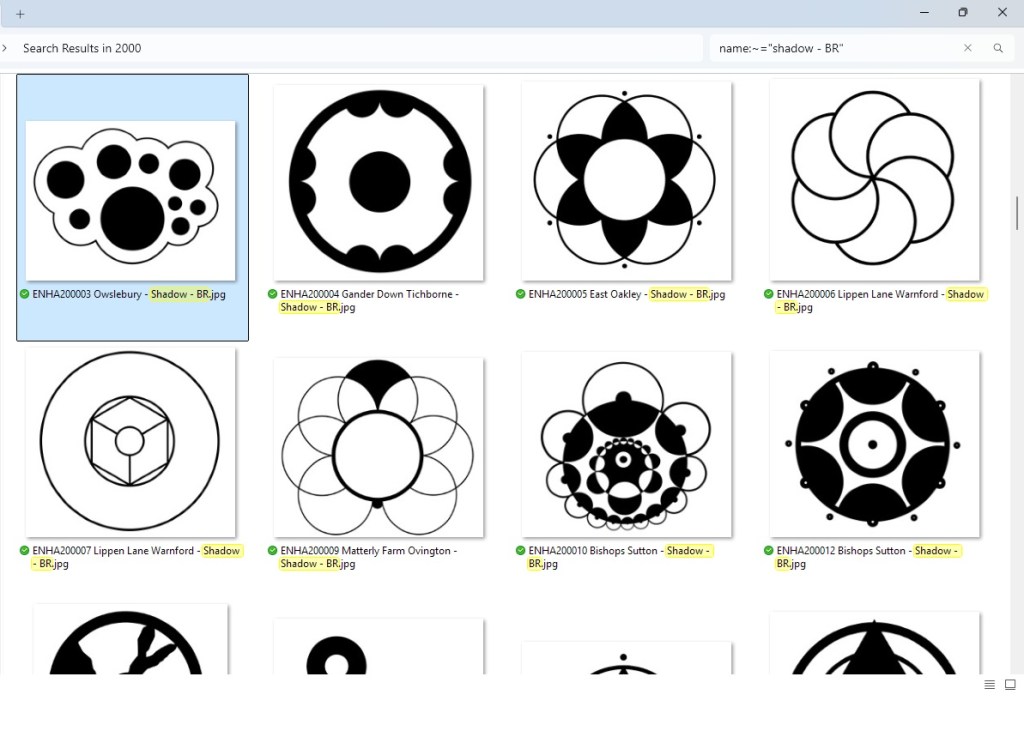
ENHA200004 Gander Down Tichborne – Shadow – BR
can be broken down as follows:
- EN – 2 character Country code for England
- HA – 2 character County, State or Province code for Hampshire
- 2000 – 4 digit Year
- 04 – 2 digit Serial Number to prevent duplicates for that Country / County / Year
- Gander Down – The Place of the formation
- Tichborme – The Nearest Town or Village
- Shadow (diagram) – The Type of File
- BR (Barry Reynolds) – The Copyright Holder
- n/a – A Sequence Number to prevent duplicates
This enables queries to be run over the database for simple as well as highly complex data extractions e.g.:
- All formations within a given County for a given Year
- All formations within a given Place e.g. Gander Down irrespective of date
The full list of available File Type is as follows:
- Advert – many formations have been man-made for advertisements
- Anomaly – photographs or reports of anomalies seen over or near crop circles
- Article – crop circle journals published lengthy articles on specific formations
- Calendar – crop circle calendars have been produced annually since the early 1990s
- Corres – in the days before the internet and email, written correspondance was used between researchers
- Geometry – the geometric layout of formations is often highly complex
- Featured – there is so much information relating to some extremely well-known formations that it has been pulled together into a single report
- Media – magazines and newspapers have run countless articles over the years
- Photo – all photographs have the back as well as the front scanned as there is often pertinent information on the reverse
- Podcast – some crop circles have their own podcast
- Postcard – these were very popular during the mid to late 1990s
- Private – some correspondance is private and will not be publicly released but remains within the physical archive
- Report – many first-hand, written reports have never previously been published
- Sample – during the mid 1990s crop samples were taken and sent for analysis
- Science – a considerable amount of scientific research was undertaken and the results are contained within the archive
- Shadow – black and white shadow diagrams are often the quickest way to identify a formation or compare them
- Survey – researchers spent thousands of hours meticulously measuring formations
- Video – the physical archive contains hundreds of hours of video evidence
 Crop Circle Research Archive